YouTube SEO for Music Videos, Trailers and Performance Clips
Published
Category
Author

Optimise music videos, trailers & clips for YouTube Search, recommendations and lasting fan discovery with a practical release-led strategy.


Key Takeaways
YouTube SEO should begin before upload, when the edit, title, thumbnail and release path can still be shaped.
Music videos, trailers and performance clips serve different search needs, so they should not share one metadata template.
Titles, thumbnails, descriptions and the video itself help YouTube understand relevance. Viewer response then shows whether the promise was worth clicking.
Tags are mainly useful for misspellings. Time is better spent on packaging, captions, playlists, retention and the next viewing action.
Entertainment teams often leave YouTube SEO until the final upload screen. The master has been approved, the premiere is scheduled and the media plan is ready. Then someone asks which tags should be added.
That sequence is backwards.
Tags play only a limited role in discovery. The bigger decisions were made earlier: what the asset is called, which fan need it answers, how the thumbnail sets expectations, what happens in the opening moments and where the viewer should go next.
Good YouTube SEO is not a box-ticking exercise. It is part of the release architecture.
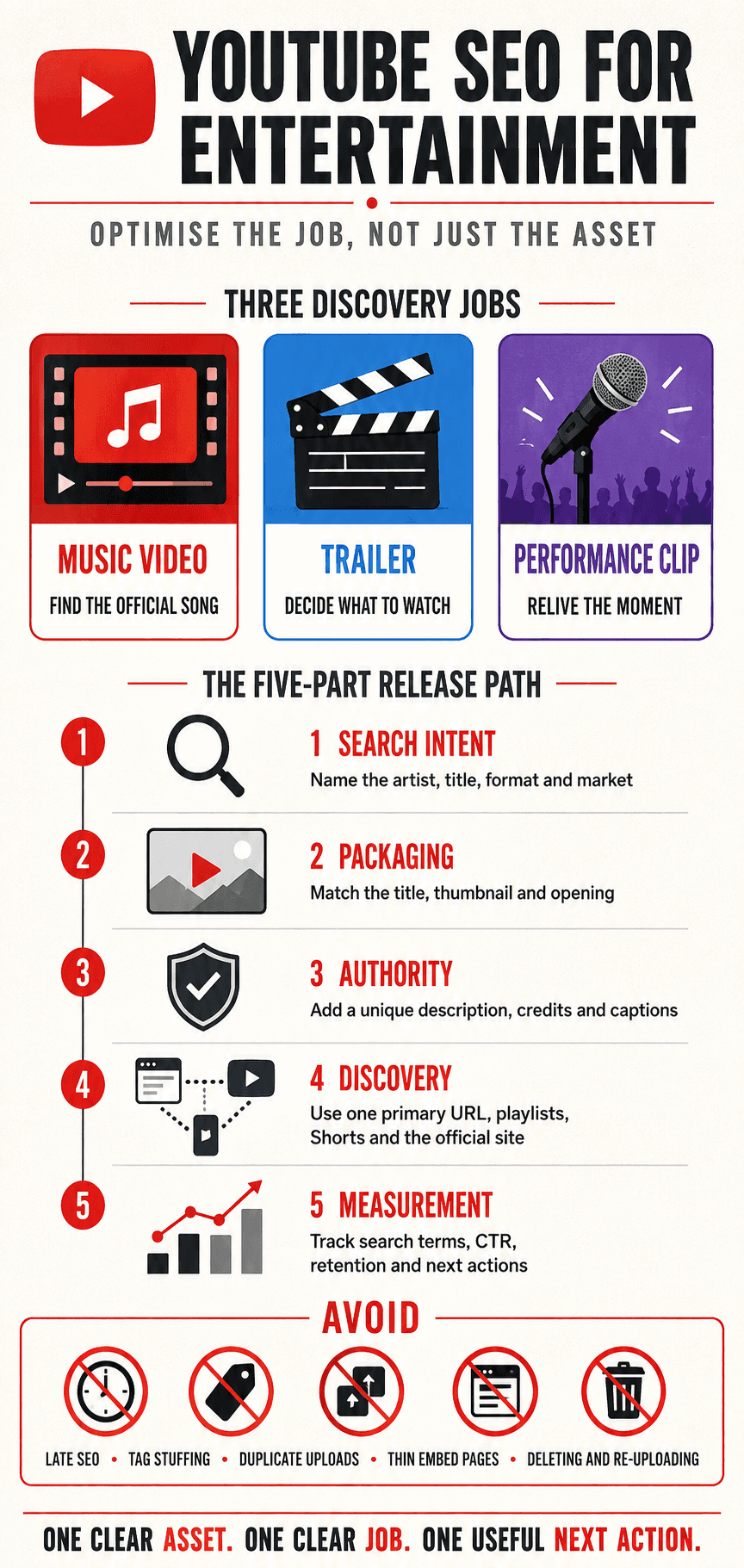
One Platform, Three Different Discovery Jobs
A music video, trailer and live performance may all be video files, but people do not search for them in the same way.
A music video helps a fan find the official version of a song and continue into the artist’s wider catalogue. A trailer helps someone decide whether, when and where to watch a film. A performance clip lets an audience find or relive a particular song, venue, festival or cultural moment.
This gives each format a different discovery half-life.
Format | Main discovery job | Typical search pattern | Discovery half-life |
Music video | Find the official song visual | Artist + song + official video | Can grow for years and return during tours, trends, syncs and anniversaries |
Trailer | Decide whether and where to watch | Film title + trailer + territory, year or release detail | Usually peaks near release, then can return at home entertainment or streaming launch |
Performance clip | Find or relive a specific moment | Artist + song + live + venue, event or year | Often reactivates when the song, artist or event becomes relevant again |
The practical lesson is simple: optimise for the fan’s job, not just the asset type.
Name the Asset the Way a Fan Would Search
The title should make the entity and format unmistakable. Clever campaign language can still appear, but it should not hide the artist, song, film or event that creates the search demand.
Useful title structures include:
Music video: Artist Name - Song Title (Official Music Video)
Trailer: Film Title | Official UK Trailer | In Cinemas 18 October
Performance clip: Artist Name - Song Title (Live at Venue, 2026)
These are structures, not rigid rules. Use the language the audience recognises and only use labels such as “official” when the channel has the right to make that claim.
Avoid vague titles such as “New clip out now”. They age badly in search and make the asset harder to distinguish from reactions, reposts and fan uploads.
Treat the Thumbnail and Opening as One Promise
The title and thumbnail earn the click. The opening proves whether that click was deserved.
This is where entertainment assets can create an avoidable gap. The thumbnail promises a recognisable star, scene or live moment, but the video opens with a long ident, a silent card or thirty seconds of context before delivering it.
That may be creatively justified, but it should be a conscious trade-off, not an accidental one.
YouTube Search considers relevance and engagement, including whether a video earns watch time for a particular query. The first thirty seconds are not a metadata field, but they strongly influence whether viewers stay after choosing the video.
Review early retention by traffic source and audience type. A sharp fall does not automatically mean the creative is weak. It may mean the title or thumbnail created a different expectation from the edit.
Where the channel has access, test up to three title, thumbnail or combined variants in YouTube Studio. Change one clear idea at a time so the result teaches you something.
For example, test character-led against spectacle-led trailer artwork, or artist portraiture against a strong performance frame.
Describe the World Around the Video
A description should do more than repeat a standard campaign footer. Its opening lines should identify the asset in plain language and provide the most useful next step.
For a music video, that may include the artist, track, album or release, followed by a listening or pre-save link and verified creative credits.
For a trailer, include the film title, trailer type, territory, release date and official ticketing or viewing destination.
For a performance clip, include the song, performer, venue or event, recording date and relevant contributors.
Then add the information that makes the upload an authoritative record:
Rights-approved creative, production, cast, artist, songwriter and distribution credits
A concise and unique synopsis or piece of creative context
Accurate captions, the correct original language setting and chapters for longer performances or interviews
Relevant links to the release, artist, tickets, soundtrack or official website
Do not copy the same paragraph across every upload. YouTube recommends unique descriptions, and audiences benefit from details that belong to the individual asset.
Use tags for genuine name variations and common misspellings, not as a substitute for a clear title and description.
Build One Release Path, Not a Pile of Uploads
Entertainment campaigns often produce a hero video, cutdowns, teasers, Shorts, regional edits and paid versions. Without a clear hierarchy, the channel can end up competing with itself.
Choose the primary organic video for each viewing job. If rights and release dates allow, keep the main asset on one stable URL and use Shorts, clips and social edits to lead viewers towards it.
Add the primary video as the related video on relevant Shorts. Use playlists and end screens to continue the journey into the album, film, tour or wider catalogue.
If separate territorial uploads are required, make the market, language, release date or cut explicit. Identical uploads with vague labels split engagement and leave viewers and internal teams unsure which version should be supported.
Paid media can accelerate reach, but it should amplify the chosen organic asset rather than create a disconnected viewing path.
Times One Hundred’s guide to YouTube advertising for entertainment brands explains how paid activity can support audience building and re-engagement around releases.
Make the Official Website Part of Video Discovery
YouTube is often the viewing destination, but Google Search may surface either the YouTube URL or a page on the official website. Entertainment teams should decide which role the website plays.
If watching the video is the main purpose of a page, give it a stable, indexable URL, a unique title and useful supporting copy.
Keep the video prominent and discoverable without requiring a user interaction to load the primary content. Add accurate VideoObject structured data, use a stable thumbnail URL and consider a video sitemap for a substantial library.
Do not create dozens of thin pages containing the same embed and a sentence of copied content.
A film review, news post or product page with a supporting trailer is not automatically a dedicated watch page. Build a separate page only when it serves a real audience need.
This is where a joined-up SEO and GEO strategy matters. The channel, release page, structured data, internal links and measurement plan should describe the same asset consistently.
Measure Success by Format and Release Stage
There is no single YouTube SEO metric. Views can come from paid promotion, existing subscribers, external embeds, Browse, Suggested videos or Search, and each source tells a different story.
Asset | Useful organic measures | What the team is trying to learn |
Music video | YouTube search terms, Search and Suggested watch time, returning viewers, playlist continuation and tracked clicks to listen | Is the video becoming part of the artist’s catalogue discovery? |
Trailer | Organic reach before and after release, click-through rate, retention through the release message and tracked clicks to tickets or viewing options | Does the packaging attract the right audience and carry them towards release intent? |
Performance clip | Searches containing the song, event or venue, subscriber contribution, adjacent video views and returning viewers | Can a single live moment open a longer journey through the channel? |
Separate paid and organic behaviour where possible.
Review the first 48 to 72 hours for packaging or retention problems, but do not treat that as the final verdict. Search demand may build slowly, while a trailer can receive a second wave when reviews, awards, streaming availability or cast news renew interest.
At around 30 days, compare the video with other uploads of the same format and length.
A music video should not be judged against a teaser. A three-minute performance should not be benchmarked against a full concert film.
What Usually Goes Wrong
The most common YouTube SEO failures are rarely technical mysteries. They are ownership and workflow problems:
SEO is requested after the edit, artwork and release plan are locked.
The title prioritises campaign language but omits the entity people search for.
Boilerplate descriptions hide the unique release details.
Teams spend time on long tag lists while captions, credits and playlists remain incomplete.
Multiple channels upload near-identical cuts without a defined primary version.
Poor packaging is “fixed” by deleting and re-uploading the video, losing the URL, engagement history and existing links.
Every format is judged by total views, even when the commercial and audience jobs are different.
The remedy is to assign one owner before launch.
That person does not need to control the creative. They need authority to confirm the primary URL, metadata, thumbnail variants, captions, release links, playlist placement, website support and reporting plan.
For high-stakes releases, this joined-up approach is part of effective entertainment and media marketing. It helps the campaign capture immediate attention without sacrificing the longer discovery life of the asset.
Final Thoughts
YouTube SEO cannot manufacture interest in a song, film or performance. It can make sure existing interest reaches the correct official asset, understands what it has found and continues into a useful next action.
The strongest optimisation does not begin with tags. It begins with a clear answer to three questions:
What discovery job does this video perform?
Which version owns that job?
What should the viewer do after watching?
When those decisions are made before upload, a launch asset can do more than peak for a weekend. It can become part of a discoverable catalogue that keeps working whenever attention returns.
Frequently Asked Questions
Are Tags Still Important for YouTube SEO?
Tags have a limited role and are mainly helpful for common misspellings or name variations. A clear title, strong thumbnail, unique description, accurate captions, and satisfying viewing experience deserve more attention.
Should Every YouTube Video Have a Page on the Official Website?
No. Create a dedicated page when watching the video is a main reason to visit and the page can add useful, unique context.
If the video only supports another page, such as a film review or product page, keep it as complementary content rather than creating a thin watch page.
Should a Trailer Be Updated After the Film Leaves Cinemas?
The video itself may remain valuable, but its surrounding information should stay accurate.
Update the description and links when the film moves to rental, purchase, or streaming, while preserving the historical release context and stable video URL.
Related Articles